ORANGE JUNE · OPEN LETTER · GUN VIOLENCE AWARENESS MONTH
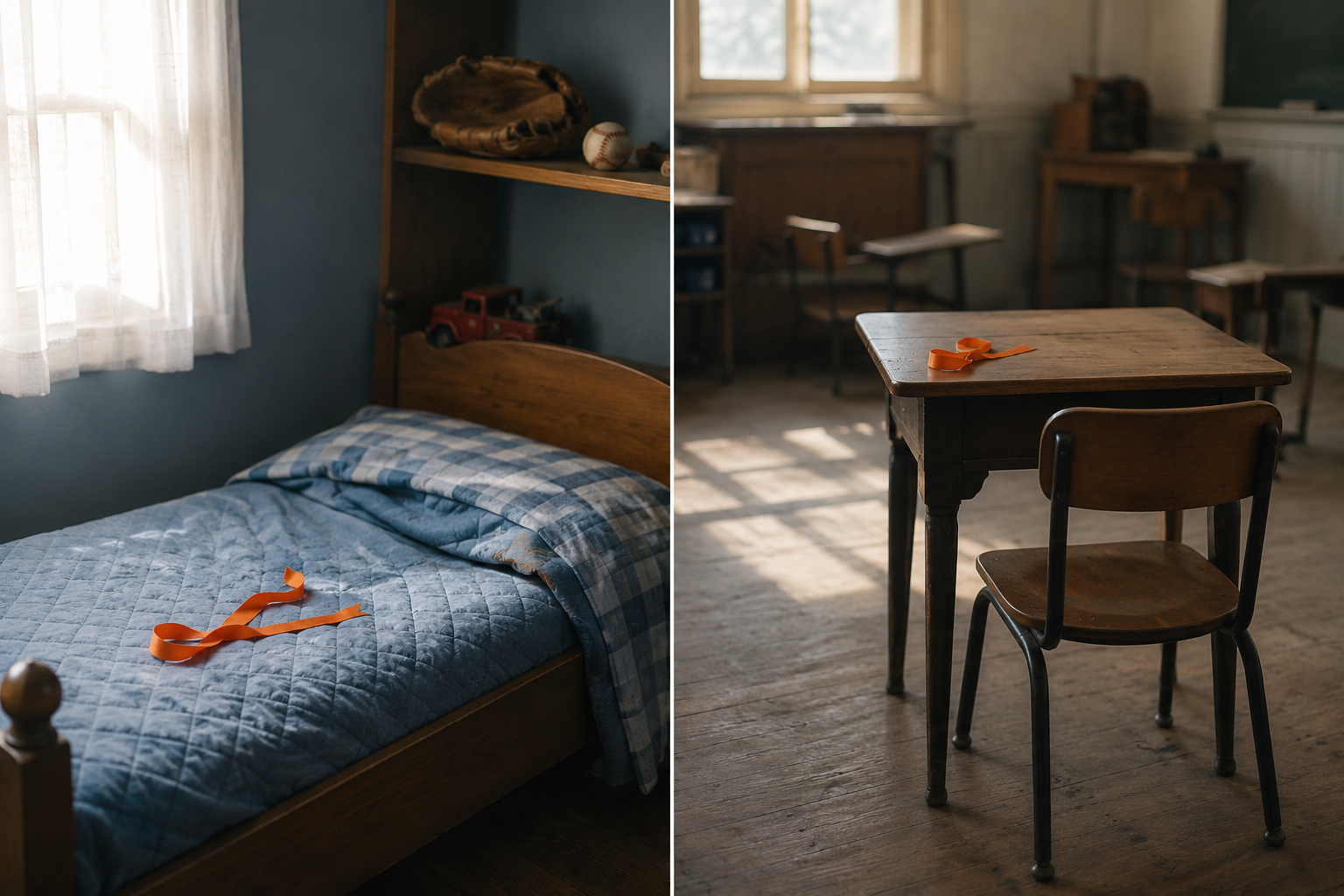
His bedroom is exactly as he left it. Her desk is still in the classroom. Almost ten months after Annunciation, a stranger says Fletcher and Harper out loud.
On August 27, 2025, a gunman fired through the windows of Annunciation Catholic Church in south Minneapolis during a back-to-school Mass, killing eight-year-old Fletcher Merkel and ten-year-old Harper Moyski and wounding twenty-one others, most of them children. Almost ten months later the cameras are long gone and the families are still here — keeping a bedroom intact, holding onto an empty desk, carrying a grief that colors every ordinary hour.
By Michael · June 16, 2026
Dear Mollie, dear Jackie,
This is Orange June — the month I write letters to people touched by gun violence — and this is one of the soft ones. There are two mothers, two children, and an ordinary school morning that the rest of the country watched for about three days last August and then let go of. You haven't had the luxury of letting go of it. I'm writing in June because June is the one month the country agrees to look, and I wanted at least one of these letters to reach the people still standing in the part that doesn't make the news: the tenth month.
On the morning of August 27, 2025, the children of Annunciation Catholic School were three days into the school year, gathered for a back-to-school Mass in the church in south Minneapolis. A little after eight-thirty, a person with a rifle came to the side of the building and fired through the windows, into the pews where the kids were praying. I'm going to name the weapon and leave most of the rest of it alone, because the weapon is the part that doesn't get argued. The fights over who and why will go on for years. What turned a sanctuary full of grade-schoolers into the worst day of your lives, in a matter of seconds, was an AR-15-style rifle — 116 rounds fired through those windows and into the pews — and every gun carried into that church that morning had been bought legally. A weapon built to do exactly that, that fast.
· A PERSONAL NOTE ·
I should tell you why this one is different for me. I went to Catholic school for ten years, kindergarten through ninth grade. I know exactly what that room of pews looks like — and what it smells like. I can picture it perfectly from my own childhood: a place of peace, of calm. I've since lost my connection with the church, but I have never lost those memories — the chapel, the other kids, the quiet, and more than anything, the safety. That is the word that stays with me. Safety. It is why this story reaches deeper in me than any other I have written this month. And there is one number that caught me completely off guard, that I cannot get past: 116. That is how many shots were fired into a room full of children. One hundred and sixteen. Into the safest room I ever knew. And it lasted two minutes and thirty-four seconds — a hundred and sixteen rounds in a hundred and fifty-four, a shot into that room about every second and a half. I keep doing that math, and I keep wishing it would come out wrong.
Fletcher Merkel was eight. He loved, in his father's words, any sport that he was allowed to play. Jesse asked the world to remember him for the person he was and not the act that ended his life, and I'm honoring that here. He was the second of four. Two of his siblings — Milo, a fifth grader, and Hazel, a second grader — were inside that same chapel when the shooting began, and they lived; the youngest, three-year-old Rory, was safe across town with their grandmother. Three children carry the wound now, two of them old enough to remember the room.
Harper Moyski was ten — a big sister, and the word everyone who knew her kept reaching for was joyful. Her family said her light will always shine through us. Bright, joyful, deeply loved.
Eight and ten. A boy with a season he never got to play, and a girl who was somebody's big sister.
Twenty-one other people were hurt that morning, most of them children. In the first accounts, the thing the principal could barely get out through tears was that the older kids had thrown themselves over the younger ones. That detail has stayed with me for almost a year now — children doing in a half-second what a country full of grown adults has refused to do in a decade.
Jackie — a few weeks later, at the gathering to honor Harper, you told the people who came that their support had lifted your family at a moment when it felt as if it had been dropped at the bottom of an ocean. I've thought about that sentence a lot. I don't have a better one for what this does to the people it leaves behind.
Here is why I'm writing now, in June, and not last August. This spring a reporter went back to you — almost nine months on — and found what the cameras never stay long enough to see. Mollie, you and Jesse were sitting in Fletcher's bedroom, kept the way he left it. Harper's desk is still in her classroom, and her friends have spent the whole school year holding onto small reminders of her.
One of you said the truest thing I have read about any of this. The trauma colors everything. In class, at home — every ordinary hour of the day.
· THE REPORTING ·
This letter exists because CNN went back almost nine months after the shooting — into Fletcher's bedroom, into Harper's school — when the rest of the country had already moved on. That kind of return is the whole job of local and national reporting: to keep looking after the cameras leave. The families let them in. The least the rest of us can do is read it.
cnn.com — The shooting finally stopped. Then came everything else (May 17, 2026) →That's the part I wanted on the record. The country films the first seventy-two hours — the candles, the press conferences, the flags at half-staff — and then the trucks pack up and drive to the next town's worst morning. But grief doesn't run on a news cycle. The tenth month, when it's quiet again and everyone else has moved on, is usually when it gets heaviest. Somebody outside Minnesota should be willing to still be looking after the lights are off.
And I have to say one hard thing, because it happened in your own state. In May, Democratic lawmakers in the Minnesota House began a sit-in on the chamber floor and refused to leave, because the speaker wouldn't let a gun-violence-prevention bill come up for a vote. Not lose a vote — come up for one. Almost a year after Annunciation, in the very building where your state writes its laws, the room still couldn't agree to look the question in the face. I'm not putting that on you. I'm putting it where it belongs: on a machine that treats a vote as a favor it gets to withhold.
Here Is Where You Can Help
The nonpartisan organization Fletcher's and Harper's own parents founded after the shooting. They have lined the Minnesota Capitol grounds with empty school desks — one for every child lost — to push for the assault-weapons and high-capacity-magazine limits that might have kept 116 rounds out of that sanctuary. It is their fight, in their children's names. Not us — them.
Donate to Annunciation Light Alliance →Goes straight to them. Not to us — we never take a cent.
Orange June exists to keep saying the one thing that machine talks over: name the weapon. Evil is not new — it has always been in the world, and it always will be. What was new in that sanctuary was a gun that could empty into a crowd of kneeling children faster than a church could carry them out. That is the part we are actually allowed to change, and the part the country spends eleven months a year agreeing not to.
You should know who's writing, because it's a stranger. I run a small paper from out of state, on almost no money, and I take no one's check — no ads, no donors, nothing to sell you and nothing to ask of you. I found you the way the whole country should find its neighbors: through a reporter willing to sit in your homes almost a year later, when it would have been easier to write about something newer.
I won't pretend to know what this has cost you. I have children of my own, and I know that I don't know — that I can't, and that I hope to God I never do. What I can do, from a desk a long way from Minneapolis, is the one thing this page is for: say them out loud, on purpose, in the month the country is finally listening. Fletcher Merkel, who was eight. Harper Moyski, who was ten.
In your first statements, when you had every reason to say nothing at all, you asked the rest of us for one thing: go give your kids an extra hug. I did, the night I read it, and I will again tonight. Thank you — for that grace when you owed us none of it, for keeping a bedroom and a desk exactly as they were, for letting a reporter back in so the rest of us would have to keep looking. Their names are Fletcher and Harper. I'm sorry it takes an orange month to make a country say them. I'm saying them anyway.
— Michael
Spotlight Dispatch · Orange June · Day 10 · June 16, 2026
michael@spotlightdispatch.com
Be sure to visit our Facebook page for updates and to connect.
Related Coverage
You spent hours on the floor of Pulse while a gun killed 49 people around you. Ten years later, you're building the room you needed.
June 13, 2026
You lined a Milwaukee boulevard with orange signs so the city would look its number in the face. The number is down this year. It is still 43 signs.
June 11, 2026
You lost your son in 2012 and built a place so no one walks through it alone. Yesterday, Louisville walked with you.
June 7, 2026
Further Reading
Spotlight Dispatch