REPORT · SAUDI ARABIA · IRAN · THE RECORD
Trump signed a nuclear deal with Saudi Arabia on Wednesday and broke it himself on Thursday — the second peace he has signed and broken in six weeks.
For the second time in six weeks, President Trump made a peace deal and broke it — this week a civil nuclear agreement with Saudi Arabia, signed on Wednesday and made “totally subject to” Saudi normalization with Israel on Thursday, one day later. The official version is a “new condition.” The reality is simpler: he signed it, and he broke it. Strange moves for the man who wrote The Art of the Deal.
By Michael · July 24, 2026
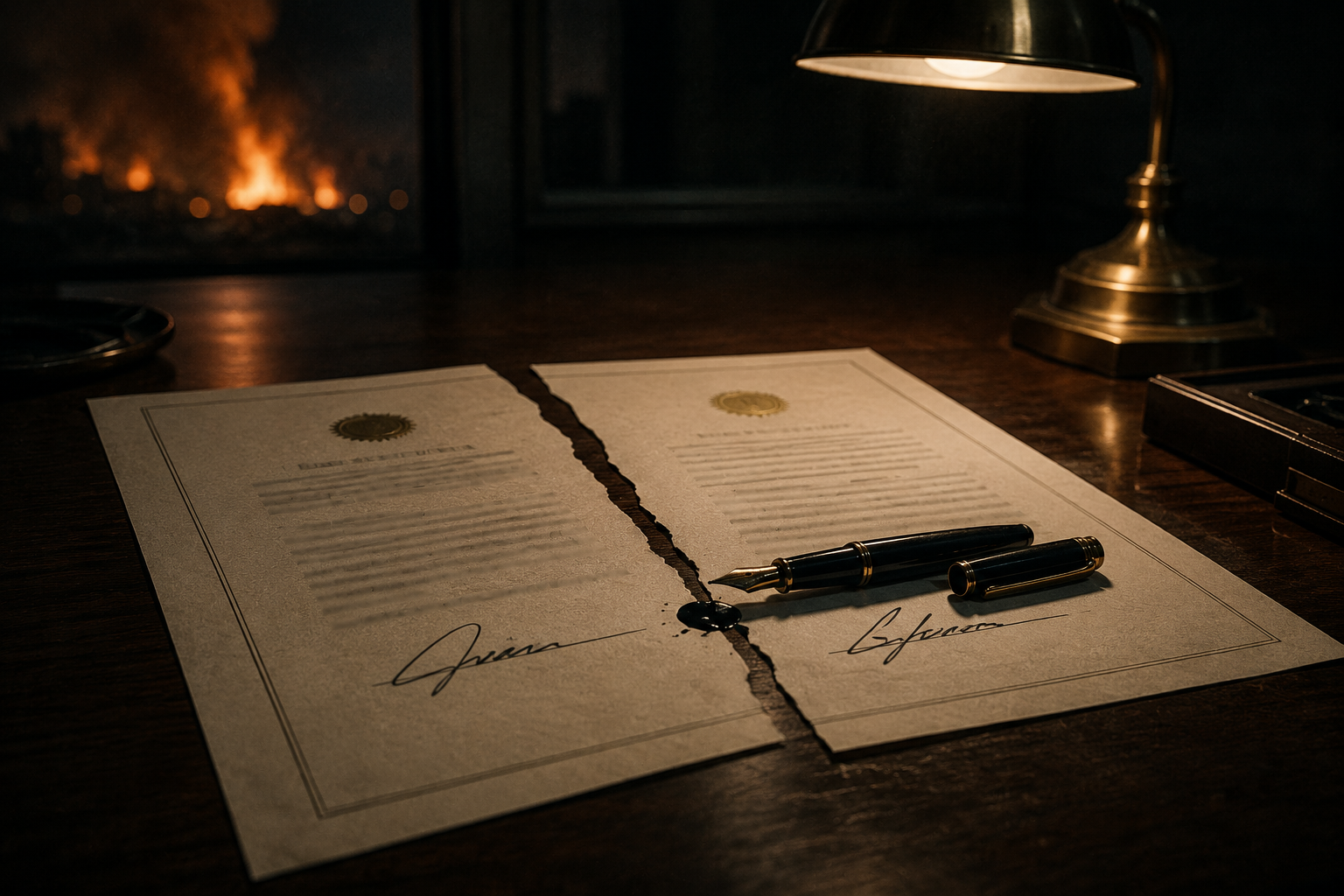
Two days, two headlines, one pen. On Wednesday, July 22, the Trump administration signed a civil nuclear agreement with Saudi Arabia — American companies to build and run the kingdom's reactors, peaceful use only, no uranium enrichment. It was months of quiet work, the kind of deal everyone said could not be done. And then on Thursday, July 23, one day later, the President went on his own website and wrote that the signed deal “will be approved, but is totally subject to Saudi Arabia joining the very respected and successful Abraham Accords.” In one sentence he made his own signature conditional on Saudi Arabia doing a second, far larger thing it has refused to do for a generation: normalize relations with Israel. He signed the page on Wednesday and took it back on Thursday, over Riyadh's head, in twenty-four hours.
· SIGNED WEDNESDAY · BROKEN THURSDAY ·
— WEDNESDAY, JULY 22 — The Trump administration signs a civil nuclear cooperation agreement with Saudi Arabia: U.S. companies to build and operate the kingdom's reactors, peaceful use only, no uranium enrichment. (NPR) — THURSDAY, JULY 23 — One day later, the President posts that the signed deal “will be approved, but is totally subject to Saudi Arabia joining the very respected and successful Abraham Accords” — i.e., normalizing relations with Israel. (CNN; ynet) — Nobody in Riyadh agreed to that before Wednesday. The condition was added after the signature, in a social-media post, over the kingdom's head. — Israel, for its part, was alarmed the deal happened at all — a sign the President and his closest ally are drifting apart. (NPR)
The wire copy had a word ready for it: a new condition. Trump places a new condition on the Saudi nuclear deal. Nobody in Riyadh agreed to the Abraham Accords clause before Wednesday. It arrived after the signature, in a social-media post, as a fact the kingdom was expected to accept or watch the agreement evaporate. That is not a condition. That is a deal signed and then broken by the man who signed it, one day apart.
· A TERM, OR A BREAK ·
A condition you agree to before you sign is a term of the deal. A condition you add the morning after is something else.
The thing he is demanding is not, on its own terms, unreasonable — and it is worth saying so, because the sequence is the story and the merits are not. Israel had a real fear: that a Saudi road to enriched uranium could touch off a nuclear race in the most dangerous neighborhood on earth. Wanting the agreement locked to no enrichment and tied to normalization is a defensible thing to want. If he wanted it, the months of negotiating were the time to get it. You do not put your name on the page and then, the next morning, tell the other country the page is void unless they cross the one line they have held for years. The demand may be right. The timing is what turns a hard bargain into a broken deal.
And it is the second time this summer the same thing has happened. Six weeks ago, in the middle of June, the President signed an interim ceasefire meant to end the war with Iran. Within hours it was coming apart, and by the first week of July it was gone. At the time it was possible to argue about who broke it: Iran fired missiles at commercial tankers in the Strait of Hormuz, and Israel struck Lebanon within hours of the signing while a minister in its own cabinet said out loud that Israel “will not allow” a Trump–Iran peace. Two hands, at least, on that one. This time there is no argument to have. There is one hand, and it is holding a pen, and it broke its own deal in writing.
And that is the strange part, because of the brand this particular man built his whole life on. This is the President who put his name on The Art of the Deal, who has called himself the greatest dealmaker the country has ever produced, who ran on the promise that he alone could sit across a table and walk away with what no one else could get. The entire value of that brand is the signature — the idea that when this man shakes on a thing, it holds. Two peace deals in six weeks, both signed in front of the cameras, both undone before the ink was dry. So it is fair, finally, to ask the question the brand was built to keep anyone from asking: the king of the deal, the man who wrote the book on it — does anyone still believe that?
The honest answer is that the dealmaking may never have been quite the point. Look at the two deals side by side and the same shape appears in both: this is a President for whom the signing is the event and the peace is the afterthought. The signing is where the cameras are, where the word historic goes, where the phrase gets minted that everyone repeats for a day. And then the cameras move on, and within hours or within a day the thing comes undone — from the other direction with Iran, by his own hand with Saudi Arabia — and the undoing is handed to the country under a smaller word than the signing got. A man does not sign and break two peace deals in six weeks by accident. He does it because the announcement was the product all along.
The war that June ceasefire was supposed to end did not pause when the cameras left. It has become the worst version of itself. Iran's own president now calls it a full-scale war. The United States has bombed Iran on eleven consecutive nights, expanding from ships in the strait to bridges, power stations and ports in the north of the country. Iran counts more than fifty of its people dead and five hundred wounded. Three American soldiers are dead — two in Jordan, one in Iraq — and seventeen service members have been lost since the fighting began in February. Brent crude is above ninety dollars a barrel. The President says he hit Iran “very hard” in the soldiers' honor, that he is “not finished,” and has threatened a “massive” new escalation.
· THE CEASEFIRE, ON ITS ELEVENTH NIGHT ·
— The June interim ceasefire with Iran has fully collapsed; Iran's President Pezeshkian calls it a “full-scale war.” (BBC) — The U.S. has struck Iran on eleven consecutive nights, expanding from the Strait of Hormuz to bridges, power stations and ports in the north of the country. (AP) — Iran reports 50-plus killed and 500-plus wounded since the renewed strikes; three U.S. soldiers have been killed — two in Jordan, one in Iraq — with 17 service members lost since the war began February 28. (AP; BBC) — Brent crude is above $90. Trump says the U.S. is “not finished” and has threatened a “massive” new escalation. (NBC News)
There is a quiet arithmetic in the words we are using for all of this. The Saudi break gets called a “condition.” The Iran war gets called a “ceasefire” that “frayed.” Both words do the same soft work — they take a thing a man chose and make it sound like weather, something that happened on its own while everyone stood around regretting it. A ceasefire is not fraying when it is on its eleventh night of airstrikes and burying American soldiers. That is a war. And a deal is not developing a condition when its own author voids it the next morning. That is a break.
The record of this summer, when someone lines the headlines up in order, is simple enough to read:
Timeline
June
Trump signs a ceasefire to end the war with Iran. Six weeks later it is a full-scale war he is still prosecuting — eleven straight nights of American airstrikes.
July
Trump signs a civil nuclear deal with Saudi Arabia. He breaks it himself the next day, making his own signature “totally subject to” Saudi normalization with Israel.
Two peace deals, six weeks, one pen. There is no second government to share the blame this time, no missile from the other direction to complicate the account. He signed it, and he broke it — and it is worth writing down at its true size while it is still happening.
— Michael
Spotlight Dispatch · July 24, 2026
michael@spotlightdispatch.com
Be sure to visit our Facebook page for updates and to connect.
★ The Hole
in june it took two hands to break the peace — iran's missiles and israel's first strike. this one took one hand, one pen, and one day. he signed it, and he broke it.
Related Coverage
Trump's Iran peace deal didn't last three weeks. For the record, the first strike came hours after the signing — and it wasn't Iran's.
July 8, 2026
America threw itself a 250th birthday party and spent the weekend arguing about how full the lawn was. The count that mattered — at least 43 dead — was added up by a newspaper four thousand miles away.
July 7, 2026
This week the President told a crowd that if there are empty seats at his 250th birthday party tonight, the fake news will say he didn't fill the arena. He wrote your headline before you did. Don't take the assignment.
July 4, 2026
Further Reading
Spotlight Dispatch