EDITORIAL · THE VERDICT · A LETTER TO NO ONE IN PARTICULAR
A nineteen-year-old broke down in a Texas courtroom today, convicted of murder by a jury with no one Black on it. We never said he was innocent. We said look at the room.
On June 9 in Collin County, Texas, the all-white jury we wrote about last week found Karmelo Anthony guilty of murder in the killing of Austin Metcalf — two seventeen-year-olds, one track meet, one stabbing, in April of last year. As the verdict was read, the nineteen-year-old broke down in the courtroom, and his parents got up and walked out. He faces five to ninety-nine years. We do not know whether he did it, and we never have — our question was always the room. A second letter to Fairness, this time in sorrow.
By Michael · June 9, 2026
Dear Fairness,
A week ago this newspaper broke its own rule and wrote you a letter — addressed to no one in particular, because the someone we meant had no address and no seat in the one room where you were needed most. We told you we were not sure you had survived jury selection: a pool of 589 people in Collin County, Texas, narrowed to twelve, and not one of them Black, to judge a Black teenager. Today that jury came back.
His name is Karmelo Anthony. He is nineteen. When the verdict — guilty of murder — was read aloud in McKinney this afternoon, the boy broke down in the courtroom, his body giving way under the word, and his parents stood up and walked out, because there are sentences a mother and father cannot stay in a room to hear. That happened today. We would like you to hold it for a moment before anyone turns it into an argument.
Last week the man who builds this paper stepped out from behind our masthead and said, in his own voice, that he had once lived in Texas and did not believe this trial would be fair — not because of anything a jury might conclude about a track meet, but because of who had been let into the room to conclude it. We are not going to tell you today that he was proven right, because a guilty verdict does not prove that. He never claimed to know what happened in Frisco, and neither do we. The thing this paper has been talking about, from the first letter to this one, is the room.
Here is the record, gently and in full. On April 2, 2025, at a high-school track meet in Frisco, Austin Metcalf — seventeen years old — was stabbed once in the chest, and he died. Karmelo Anthony, seventeen then, admitted the stabbing and said he had done it to defend himself. He did not take the stand. Today a jury rejected that account and convicted him of murder, rather than the lesser charge of manslaughter the judge had allowed them to weigh. He faces somewhere between five and ninety-nine years. Because he was a child when it happened, no one could ask for his life.
People are going to be angry tonight, and we understand it from every direction. To one half of the country, this is justice, plainly. To the other half it is the thing they were afraid of all along — an all-white jury in Texas convicting a Black kid — and no headline is going to move either half an inch toward the other. That is the quiet grief underneath the loud one: the verdict cannot do the single thing a verdict is for, which is let a country agree on what happened. The room was emptied before the first witness was sworn, and an emptied room cannot hand back a trust it never held.
Let us be as careful as we know how, because in a case this raw the careful thing gets trampled first. We are not saying Karmelo Anthony is innocent. We are not saying the jurors lied, or cheated, or did anything but follow the instructions they were handed. We are not asking for him to walk free. And we are not going to let the argument about the room erase the other boy — the one who is not in any room anymore. Austin Metcalf is gone. His twin brother sat in that courtroom today and watched. Whatever else is true, a seventeen-year-old went to a track meet and never came home, and a family has spent fourteen months living inside that. Two families. One son in the ground, one son going away for most of the life he has left. There is nothing about today that is a victory.
You should know who is telling you this, because it is the only thing that makes a stranger's letter worth opening. This newspaper has no advertisers, no investors, no PAC, and no client in that courtroom — not the family, not the defense, not one of the groups that raised money around this boy's name. No one paid for a word of it. That is exactly why we can say the rest.
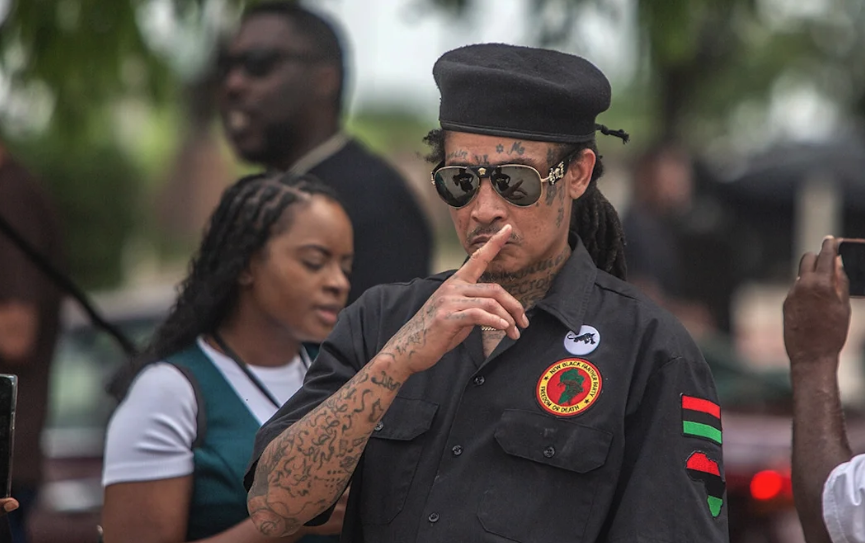
Look, last, at the people who stood outside that courthouse all week in the Texas heat — some of them in the photograph above this letter — who drove in to watch a building because they did not trust what was happening inside it. You do not post yourself on the steps of a courthouse you believe in. That crowd is the cost of the empty jury box, paid out in public, by people who had already done the same sad arithmetic we did: that a trial can be entirely legal and still not be a fair one.
So this is our second letter to you, Fairness, and it is shorter than the first, because there is less to argue now and more to grieve. We asked you last week to find your way back inside that room before the verdict. You did not make it. The door was held shut with a reason a lawyer is allowed to give and never has to mean, and the verdict came without you. It belongs to the law now, and the law is entitled to it. It is just not the country's peace, and it was never going to be — because you were struck somewhere back in that pool of 589, and a struck juror cannot un-strike a verdict.
We told you last week we would notice. We did. We are sorry it went the way we were afraid it would.
— Michael
Spotlight Dispatch
Be sure to visit our Facebook page for updates and to connect.
Related Coverage
I have no stake in this trial. But I lived in Texas — and I can tell you it will not be a fair one.
June 4, 2026
We hate you. We're asking you for five thousand dollars.
May 7, 2026
Here is every school shooting in America since 2000, counted. The line only fell the year the schools were closed.
June 9, 2026
Further Reading
Spotlight Dispatch