OPEN LETTER · GUNS · THE SEVENTH CIRCUIT · COMMON USE
Two judges read the same record on the same day. One counted how many of you bought the rifle. One counted how many people it killed.
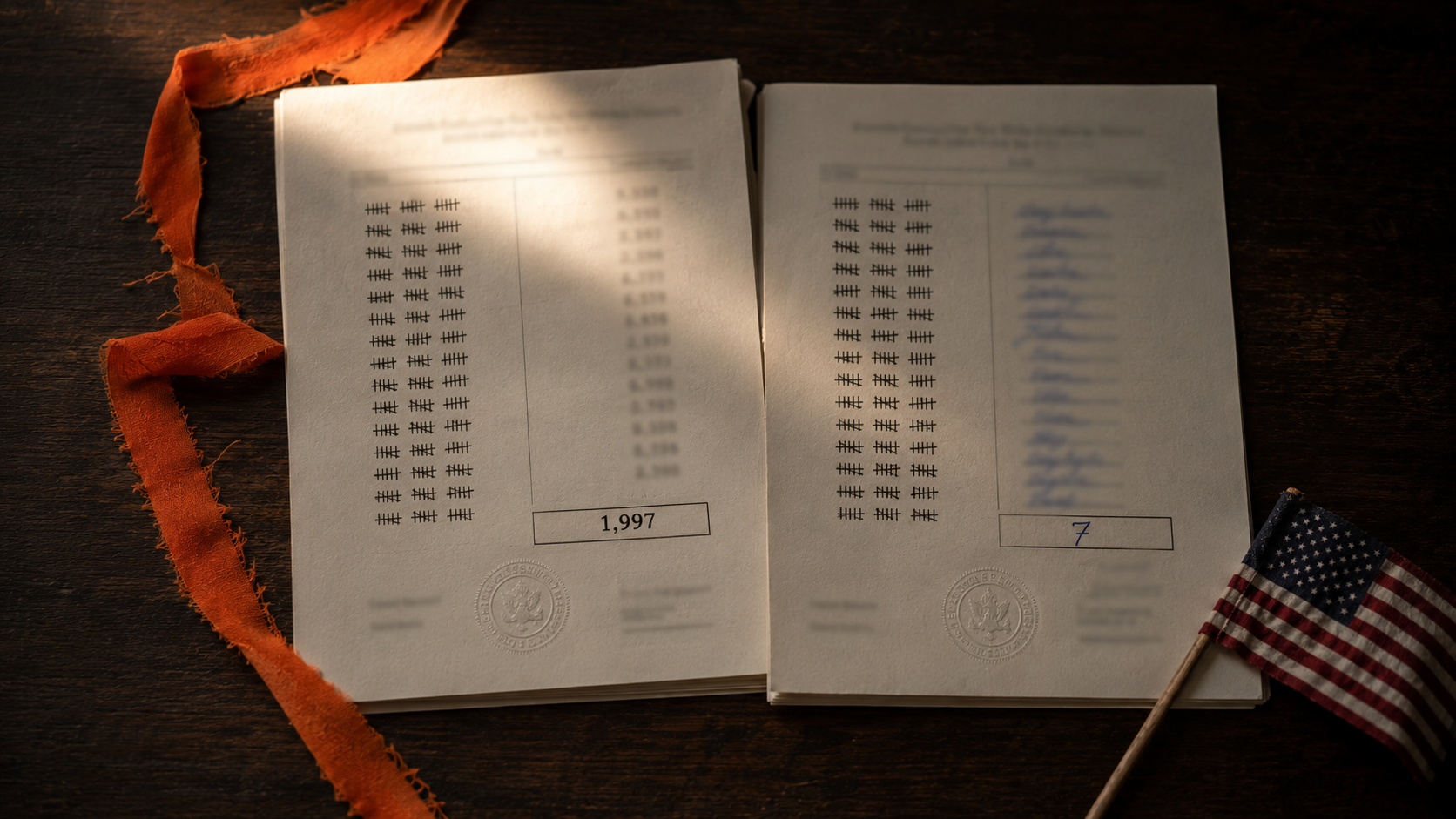
On Thursday, July 9, a federal appeals court upheld Illinois's ban on AR-15-style rifles and large-capacity magazines — the law the state passed after a man on a rooftop fired into a Fourth of July parade in Highland Park and killed seven people. The vote was 2-1. The majority opinion was written by Judge Amy St. Eve, a Trump appointee, and joined by Judge Frank Easterbrook, a Reagan appointee. Her sentence is the reason I'm writing you. “Whatever else may be contributing to America's mass-shooting epidemic,” she wrote, “the record makes one thing clear: The more people killed, the more likely it is that the killer used an assault weapon and large-capacity magazines.” The dissent, from Chief Judge Michael Brennan, answered with the other number: because Americans have overwhelmingly chosen this rifle, it is protected. Same record. Same courthouse. Same day. One judge counted the dead and one counted the buyers — and the second sentence is the one you built. In October the Supreme Court hears it.
By Michael · July 13, 2026
Dear the National Rifle Association,
On the last day of June I closed out a month of writing about guns with a letter about a phrase in your favorite area of law. The phrase is common use. I said that the test the Supreme Court is about to apply to the AR-15 counts one thing and one thing only — how many were sold — and that it has never once counted a child. I said the two numbers push the same direction: the more the rifle is used to do the unthinkable, the more it sells; the more it sells, the more common it becomes; the more common it becomes, the harder it is to ban. I said the body count feeds the sales and the sales become the legal defense. And then I put the color away for the year.
Nine days later a federal appeals court counted.
On Thursday, July 9, the Seventh Circuit upheld the Protect Illinois Communities Act — Illinois's ban on AR-15-style rifles and large-capacity magazines — and sent the case back down with instructions to rule for the state. It was 2-1. The majority was written by Judge Amy St. Eve, who was put on that bench by Donald Trump, and joined by Judge Frank Easterbrook, who was put there by Ronald Reagan. I mention who appointed them because I know how this will be sold to your members by the end of the week, and I would like the record to be sitting there first.
Here is her sentence. Whatever else may be contributing to America's mass-shooting epidemic, the record makes one thing clear: the more people killed, the more likely it is that the killer used an assault weapon and large-capacity magazines. Read it slowly, because it is not a slogan and it is not a feeling about how the rifle looks. It is a finding about a record — evidence put in front of a court, tested by lawyers who were paid to break it, and left standing. She is not saying the weapon is frightening. She is saying that as the number of dead in a room goes up, the odds that this was the weapon go up with it. That is arithmetic, and it is now in a federal appellate opinion.
· THE TWO SENTENCES ·
— THE MAJORITY, Judge Amy St. Eve (appointed by Donald Trump), joined by Judge Frank Easterbrook (appointed by Ronald Reagan): “Whatever else may be contributing to America's mass-shooting epidemic, the record makes one thing clear: The more people killed, the more likely it is that the killer used an assault weapon and large-capacity magazines.” The Illinois law, the panel held, is “consistent with our regulatory tradition.” — THE DISSENT, Chief Judge Michael Brennan: “Because the people have overwhelmingly chosen the AR-15 rifle and its magazine as their weapon of choice, they are protected by the Second Amendment.” — Both sentences are about the same rifle. Both judges read the same record. The first counts the people who died. The second counts the people who bought. (Chicago Tribune; Associated Press; Bloomberg Law)
And on the same day, in the same courthouse, out of the same record, Chief Judge Michael Brennan wrote the dissent — and the dissent counted too. It counted something else. Because the people have overwhelmingly chosen the AR-15 rifle and its magazine as their weapon of choice, he wrote, they are protected by the Second Amendment. So there are your two sentences. One judge counted the people who died. One judge counted the people who bought. Both of them were looking at the same rifle.
The second sentence is yours. You didn't write the dissent, but you have spent a generation building the argument that lives inside it, and it is the best argument you have. Popularity as constitutional shield. The rifle cannot be banned because too many of us already own one. That is the doctrine, that is what common use means in the end, and on June 30 the Supreme Court agreed to hear it — Connecticut's ban, rewritten after a man walked into Sandy Hook Elementary and killed twenty children and six adults, and the Cook County ordinance next door to Highland Park. They take the bench in October.
Now, one thing before I go further, because I would rather hand it to you than have you find it. You are not, as far as I can determine, a named plaintiff in the Illinois case. The plaintiff that came out swinging afterward was the National Shooting Sports Foundation, which says it plans to appeal. I went looking specifically to see whether I could put your name on that docket, and I could not, so I am not going to. I am writing to you anyway and you know exactly why. You are not the party in that case. You are the author of the sentence the dissent is written in.
I want to tell you what the law you are aimed at is, in case it has become an abstraction somewhere between the filing and the fundraising email. On the Fourth of July in 2022, a young man climbed onto a roof above an Independence Day parade in Highland Park, Illinois, and fired into it. Seven people were killed. Dozens more were wounded. Illinois wrote that statute in the months afterward and the governor signed it in January of 2023. It is not an idea somebody had at a conference. It is what a state does with its hands when it cannot think of anything else to do with them.
Nine days ago I wrote about the Fourth of July from a different angle — a newspaper in London ran the count of Americans shot dead over our holiday weekend, because our own papers largely didn't. I keep landing on the same date from different doors. Highland Park was a Fourth of July too. There is a version of this country where the Fourth is a parade and a grill and a kid on someone's shoulders, and that is very nearly all it is, and I would like to get back there. I think you would tell me you want that too. I am prepared to believe you.
But then I look at what the institution actually spends its hours on. Your longtime law firm has billed you at fourteen hundred dollars an hour. In 2024 you spent thirty-eight million dollars on legal fees — the largest single line on your books, more than any other thing you do. In May, when Maryland's governor signed a ban on the device that converts a Glock into a machine gun, you joined a federal lawsuit against the state the same day he signed it. Not the same week. The same day. That is what the machine is for, and it is very good at it, and none of that is a secret — you publish it.
· WHAT THE HOUR COSTS ·
— The NRA's longtime law firm, Brewer, has billed the organization at $1,400 an hour. — In 2024 the NRA spent $38 million on legal fees — the single largest expense line on its books. — The Youth Education Summit has awarded roughly $750,000 in scholarships across its entire twenty-nine-year history. That is about two cents on the dollar of one year of legal fees. — This paper covers the NRA on about $4 a day. We laid the arithmetic out in full on May 28 and May 29, and none of it has changed. (The Reload; Everytown; NRA Director of Communications, on the record)
And then there is the other number, the one I wrote about on May 29 and meant every word of. This year your Youth Education Summit gave Kaitlyn Ware of Baxter, Iowa, and Sam Poulin of Scarborough, Maine, seventy-five hundred dollars apiece toward college. They earned it — ten months of organizing, safety events for little kids, a portfolio, real work on top of being seventeen. I congratulated you for it then and I am not taking it back now. But across the entire twenty-nine-year history of that program you have handed children about seven hundred and fifty thousand dollars, total, and that is roughly two cents on the dollar of a single year of your legal fees. The kids are the rounding error. The lawsuits are the line item. You chose that, and you choose it again every April when the budget goes around.
I am not going to pretend the dissent is stupid, because it isn't, and because a letter that pretends the other side has no argument is a letter nobody has to answer. Brennan has hold of something real: a right that quietly evaporates the moment a thing becomes popular is a strange sort of right, and if the Second Amendment protects anything it presumably protects the ordinary object rather than the exotic one. Tens of millions of Americans own this rifle and have never so much as raised their voice at anybody. Eddie Eagle has genuinely taught small children to back away from a gun on a table and go find a grown-up, and I don't know how many kids that has saved but it isn't zero. The right is in the Constitution in plain English. Serious people land where I don't.
Here is what I cannot get past. Your argument and her finding do not actually contradict each other. They are the same graph read from opposite ends. The rifle earns its constitutional protection by being everywhere, and the reason it turns up at the bottom of the worst counts is that it is everywhere, and every one of those counts sells more of them. You have built a legal theory in which the weapon's protection grows with its ubiquity, and its ubiquity grows with its use, and there is no door in that room. That is the thing I would want somebody to say to me plainly if I had built it, and nobody who works for you can afford to.
So here is my ask, and it is one paragraph long and it costs you nothing you are not already paying for. When the brief goes to the Supreme Court in the fall — and one is going, whether your name is on the cover or you are funding the argument inside it — quote her sentence. In full. Not a paraphrase, not the court below erred, not a footnote burying it. Put the words the more people killed, the more likely it is that the killer used an assault weapon and large-capacity magazines into your own brief, in quotation marks, and then argue with them out loud. If the record is wrong, show the Court why it is wrong; you have thirty-eight million dollars a year of people who can. If the correlation is true but the remedy is unconstitutional anyway, then say that, in exactly those words, and let the country hear you say it. What you have never once done, anywhere I can find in your literature, is acknowledge the weapon and take the finding on its face. That is the whole ask. Acknowledge the weapon.
And if you won't do it in a brief, do it in a room. You have a Youth Education Summit coming in Washington. Kaitlyn and Sam did ten months of work to get into that room. Put Judge St. Eve's sentence on a slide in front of them and let them take a swing at it — not the talking point, the sentence. They earned a real question. If the answer is as strong as you tell your members it is, it will survive a seventeen-year-old from Iowa. If it won't survive her, that is worth knowing before October.
I already know how the week is going to be covered, so let me spare you the suspense. Fix News will run the dissent and never print the majority's sentence. Conn NN will run the majority and never print the dissent's. Each will hand the country half of a courthouse and call the half the news, and the one thing neither of them will do is set the two sentences side by side on the same screen and let a grown country look at the shape of the thing. That is all this paper does. I run it on about four dollars a day, I take nobody's money, no ads and no checks from anyone with a stake in what I write, and my real name, my real phone number and my real email sit at the top of every page you are reading — which is exactly why I can send this to you without flinching, and why there is nothing in it for me.
In October, six justices to three, they take up the rifle. When I put the orange away on the thirtieth I told the people who wore it to keep it somewhere they could reach it, because they were going to want it in the fall. I would rather have been wrong. But a Trump appointee has now written down what the record says, and a Reagan appointee signed his name under it, and that sentence is going to be sitting on the table in front of that Court whether or not anyone in your building ever says it out loud. You could be the ones who say it first. I don't expect you to. I am asking anyway, because on the off chance you do, I would print that on the front of this paper and I would mean the headline.
— Michael
The Official Internet Press Secretary
Spotlight Dispatch · July 13, 2026
michael@spotlightdispatch.com
Be sure to visit our Facebook page for updates and to connect.
★ The Hole
you have thirty-eight million dollars a year for lawyers. i am asking you for one paragraph. quote her sentence in your own brief and argue with it in the open — because the argument you are taking to that Court is that the rifle is safe from the law precisely because so many of us own one, and she just put in the record what the rest of that sentence costs.
Related Coverage
On the last day of the orange month, the Supreme Court agreed to decide whether the rifle that did Sandy Hook is too popular to ban.
June 30, 2026
America threw itself a 250th birthday party and spent the weekend arguing about how full the lawn was. The count that mattered — at least 43 dead — was added up by a newspaper four thousand miles away.
July 7, 2026
The best $15,000 you spent all week.
May 29, 2026
Further Reading
Spotlight Dispatch