Hero Spotlight Archive
August 17, 2026
Nancy Reagan
Actress, First Lady, Caregiver · She Traded One Career, Won the Hardest Room in Washington in a Single Night, and Spent Her Widowhood Losing a Fight on Purpose
1921–2016 · Fifty-two years married · Ten years as his caregiver · Twelve more at war with her own party
She has been reduced for forty years to a set of punchlines — the gowns, the china, the astrologer, the gaze. Underneath the punchlines is a woman who walked away from a working career at MGM, took the worst press any modern first lady has ever had and reversed it in a single evening by making herself the joke, moved to fire a White House chief of staff and did it, pushed her husband toward the man who ended the Cold War, and then spent ten years as his caregiver and twelve more fighting her own political party over a research question she knew perfectly well she was going to lose.
She was born Anne Frances Robbins in New York City on July 6, 1921. Her father, a car salesman, left. Her mother, Edith Luckett, was a working stage actress with a career and no way to tour with an infant, so for six years the child lived with an aunt and uncle in Bethesda, Maryland, and saw her mother when the tour came through.
That fact sits underneath everything else about her. She spent the first years of her life as the thing that got left behind so the work could continue, and she spent the rest of it deciding that when she picked a person, she was going to be there.
When she was eight her mother married Loyal Davis, a prominent Chicago neurosurgeon. He adopted her at fourteen, she took his name, and she became Nancy Davis. Smith College, drama, class of 1943. Broadway, including Lute Song with Mary Martin. An MGM contract in 1949 and eleven films across the next several years.
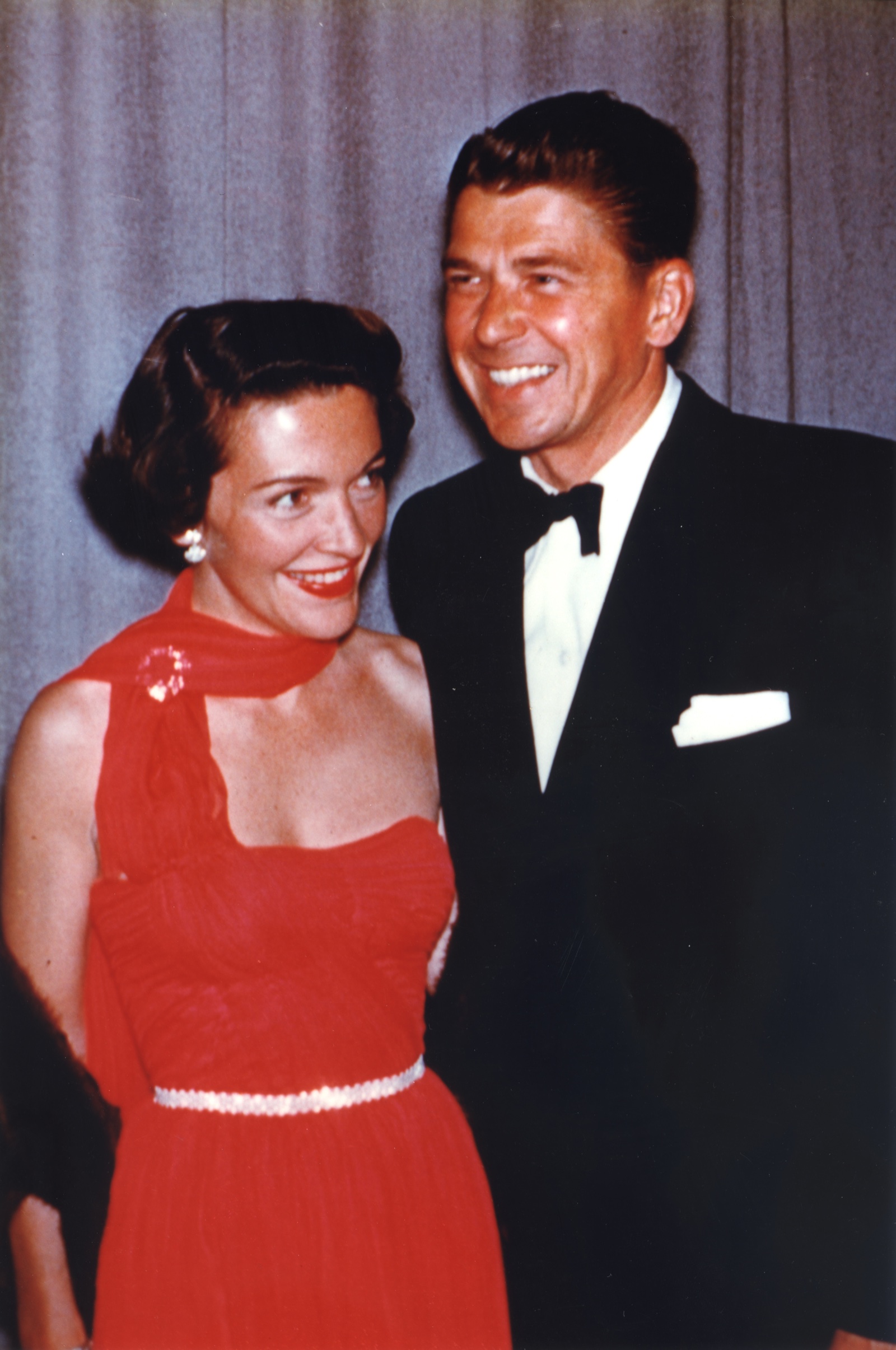
That same year she found her own name on a Hollywood blacklist of suspected communist sympathizers. It was not her; there was a second working actress with the same name. She went to the Screen Actors Guild to get it fixed and had dinner with its president. That story has its own page, the 40th first family. They married on March 4, 1952.
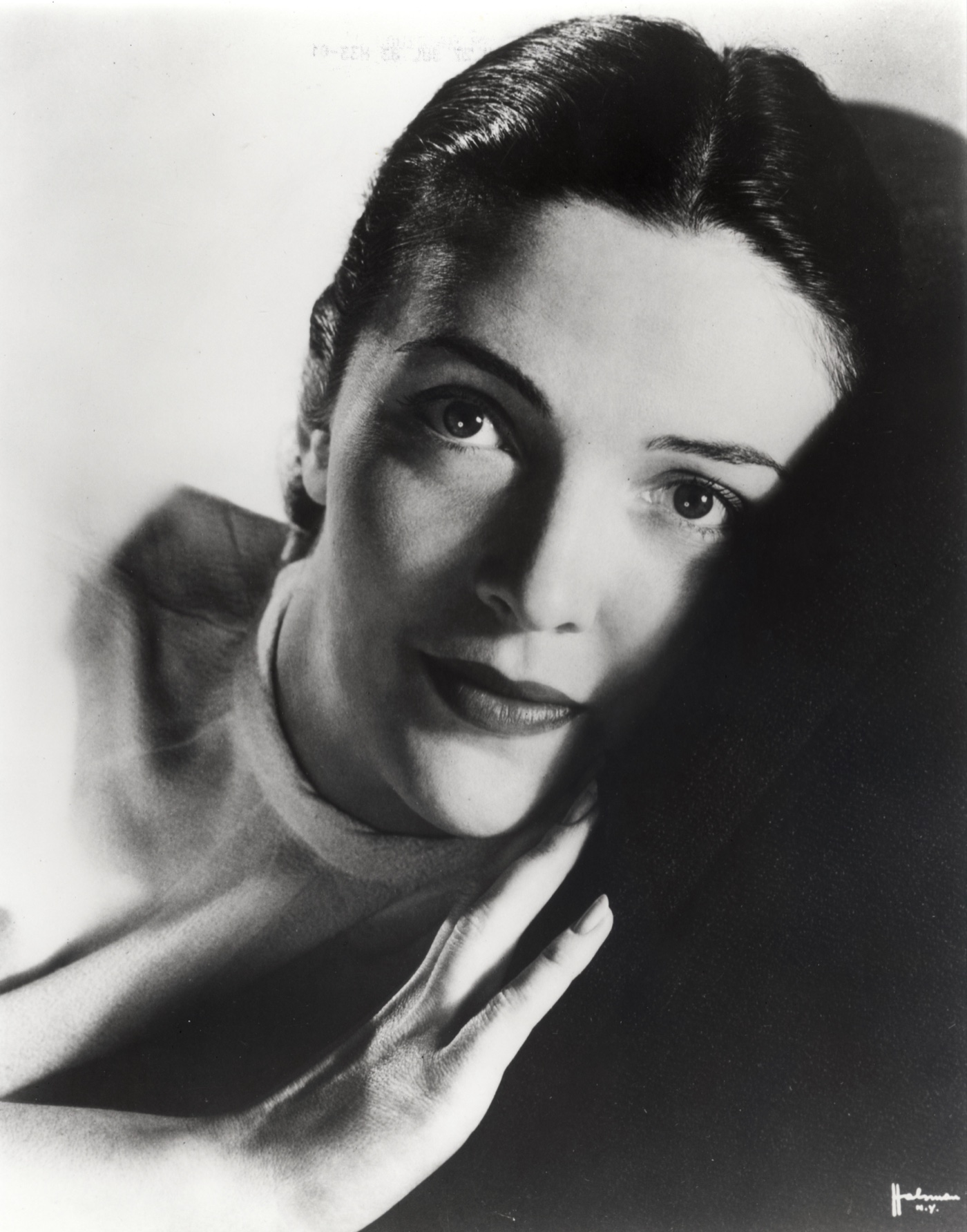
Nancy Davis, studio portrait, 1949–51. This is who she was when she went to the Screen Actors Guild to get her name off a list she was never supposed to be on.
In 1957 they made Hellcats of the Navy together — the only film they ever appeared in as a couple, and the last one she made. She was thirty-six, under contract, and working, and she stopped.
She said more than once, without hedging or apologizing for it, that her life began when she married her husband. Modern ears hear that as a small thing to say. It was not a small thing to do. She had a career and she traded it, deliberately, for the job of being one person's entire foundation, and then she did that job for fifty-two years — including the last ten, when he could no longer tell her she was doing it.
Then Washington, and the worst opening year any modern first lady has had.
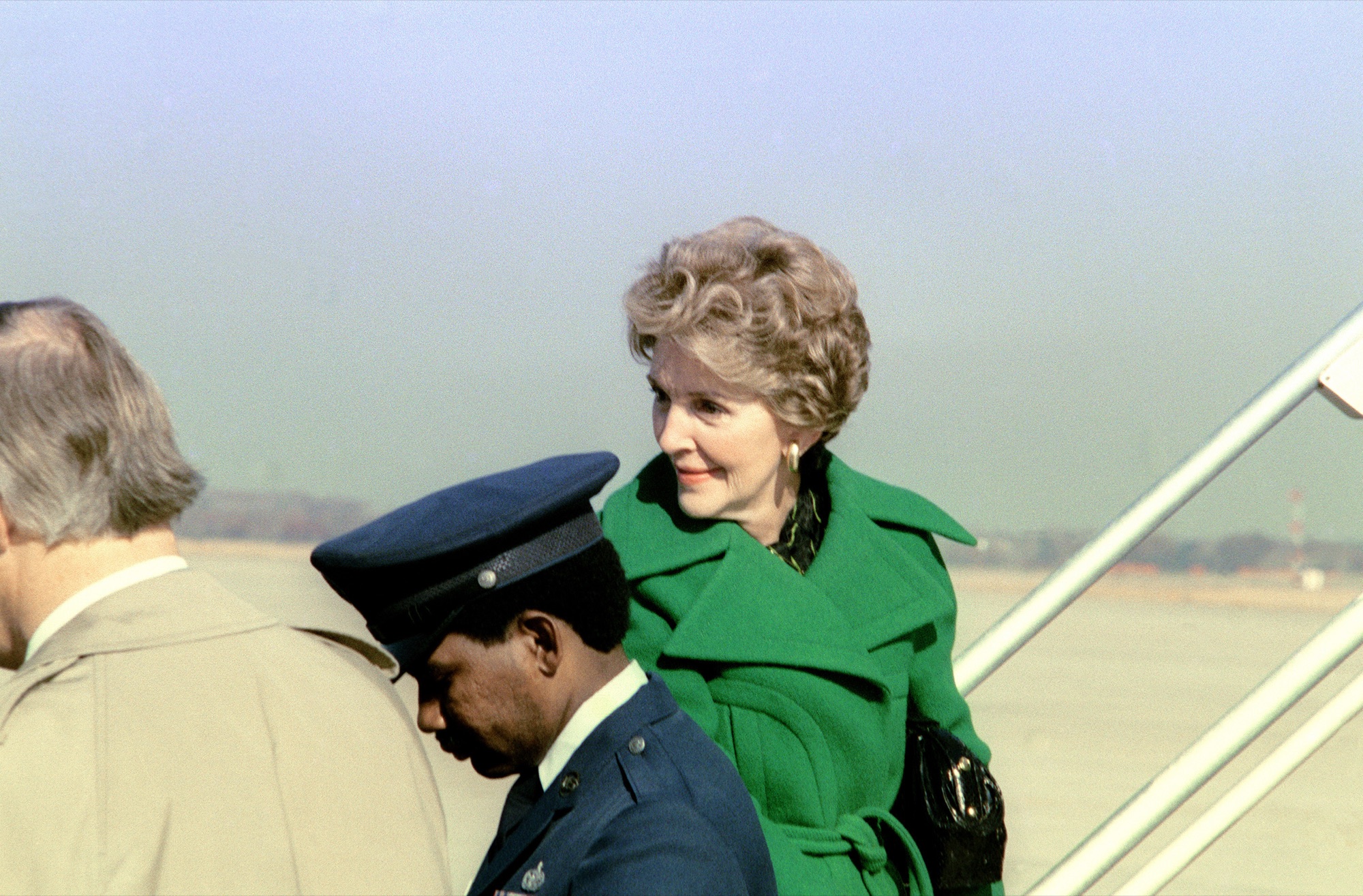
Boarding for a trip with the president-elect, who the National Archives notes is "not visible" in the photograph. Those three words are most of the next thirty-five years.
She arrived in 1981 into a country with double-digit inflation and did the precisely wrong thing at the precisely wrong moment. She raised private money to redecorate the residence. She acquired a new set of state china. She borrowed designer gowns and did not always disclose it. The coverage was savage, and in fairness a good deal of it was earned. By the end of the first year she was polling as the least popular first lady on record.
On March 27, 1982, the Gridiron Club held its annual dinner at the Capitol Hilton.
She left the head table partway through the evening. A few minutes later she walked out onto the stage in a getup assembled out of rags — a feather boa, a battered hat, yellow rubber galoshes — and sang, to the tune of Second Hand Rose, a song called Second Hand Clothes. At the end of it she picked up a plate of the new White House china and smashed it on the stage floor.
The room came apart.
March 27, 1982 — The Capitol Hilton
One year into the administration she was polling as the least popular first lady since anyone had bothered to measure it. The Gridiron Club dinner is the night the Washington press corps puts on white tie and performs songs mocking the people it covers, and the first lady is expected to sit there and smile through it. She left the table partway through, came back out onto the stage in a costume assembled from rags and yellow rubber galoshes, and sang a song about herself. Her husband was at the head table and had no idea it was coming; the staff had kept it from him so his reaction would be real. It was.
“Second hand clothes, I'm wearing second hand clothes.”
— Nancy Reagan, to the tune of “Second Hand Rose,” in front of the entire press corps that had spent a year on her
And the coverage turned, in one night, because she had done the only thing that actually works. She took the joke away from them by telling it better, in person, about herself, in front of the exact people who had been landing it on her for a year. She wrote later that it worked. It did.
That is the same instinct as I hope you're all Republicans, played in a completely different key, and it is the reason these two are on this site in the same week.
What she did with the following eight years is mostly not in the punchline file.
She started the anti-drug campaign in 1982, and the slogan it produced has been a joke for thirty years, and reasonable people can argue about whether any of it worked. What is not arguable is that she took it seriously and kept at it for the entire eight years and past them — the school visits, the constant travel, the international conference of first ladies she convened on it in 1985. She did not hand it to a foundation director and collect the credit. She showed up.
Two things she did in those years were not soft at all.
First: after Iran-Contra broke, she concluded that White House Chief of Staff Donald Regan was damaging her husband and had to go, and she worked it until he went. He went in February 1987. He was furious about it and said so in print for years afterward. She did not appear to care.
Second, and far more consequential: she pushed her husband toward Gorbachev. She wanted the arms talks. She wanted the summits. There were serious people in that administration who believed Reykjavik was a mistake and the whole diplomatic track was a trap, and she was on the other side of that argument in the only room where the argument counted. She said plainly that she wanted her husband to be the president who ended the Cold War rather than the one who fought it. He was.
Then came 1994, and the letter, and everything after it was hers alone.
She was his caregiver for ten years, almost entirely out of public view. She called it the long goodbye. What that phrase covers is a decade of a woman in her seventies and eighties tending a man who progressively did not know who she was — in a house, without cameras, for no audience and no credit, for the person who had written her letters for fifty years and could not write one now.
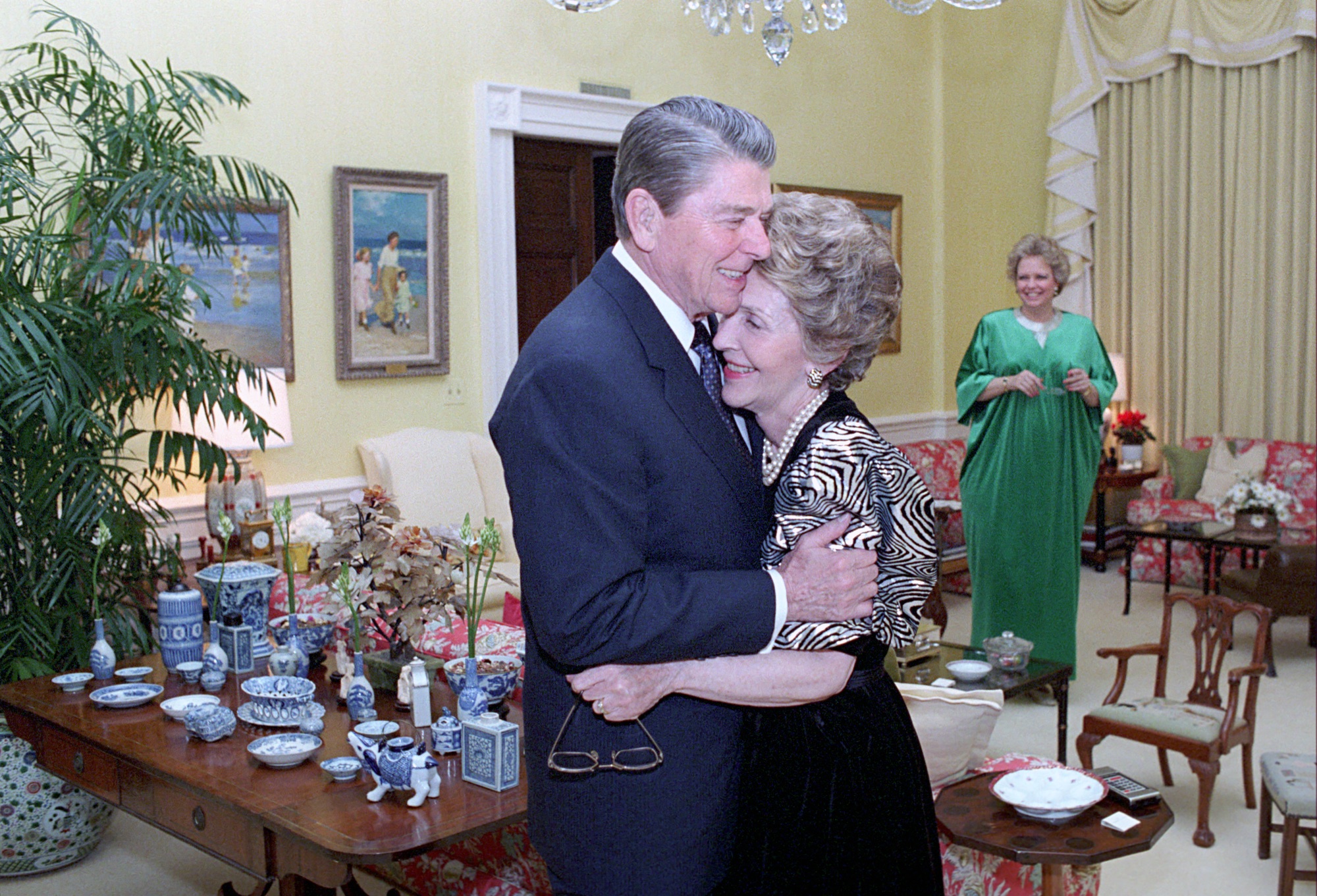
Their thirty-fifth wedding anniversary, March 4, 1987, in the residence. His daughter Maureen is across the room. The letter was seven years away.
And when it was over she did something almost nobody in her position has ever done. She went to war with her own party.
She became the most prominent Republican in the country advocating federal funding for embryonic stem cell research. She lobbied George W. Bush directly, privately first and then publicly, over a period of years. She backed the 2004 letter signed by 206 members of Congress asking him to loosen the restrictions. She is credited with pressuring Senate leadership into holding a vote on it at all. And she did all of that while also endorsing Bush's re-election in 2004 — she was not switching sides. She was fighting her own side over one thing and telling them so to their faces.
In July 2006 the bill passed the Senate sixty-three to thirty-seven and George W. Bush killed it. It was the first veto of his entire presidency. He had been in office five and a half years, and the first bill he ever refused to sign was the one Nancy Reagan had been asking him for.
She lost. She kept going anyway — the most beloved figure in the Republican Party, spending exactly that capital against a Republican president, on a bioethics question, in public, in her eighties, on behalf of families she was never going to meet.
That is the same document as her husband's 1994 letter. He wrote it down so that it would help somebody. She spent the last twelve years of her life trying to make what he wrote down actually mean something. Neither one of them was going to be around for the payoff, and both of them knew it going in.
She ran the Reagan Library. She planned and executed his funeral to the minute. She died on March 6, 2016, at ninety-four, and was buried beside him.
Fifty-two years. Ten of them keeping a promise to a man who could not hear her make it. Twelve more losing an argument on his behalf, because losing it out loud was still worth more than never making it.
She was never the punchline. We just never checked.
Ronald Reagan has his own page. The dinner that started all of it is on the 40th first family's page.
“Ronnie's long journey has finally taken him to a distant place where I can no longer reach him.”
— Nancy Reagan, Beverly Hills, May 2004 — the speech that made her the most prominent Republican in America arguing against her own party
Spotlight Dispatch
These people were real. This praise is earned.