Hero Spotlight Archive
August 17, 2026
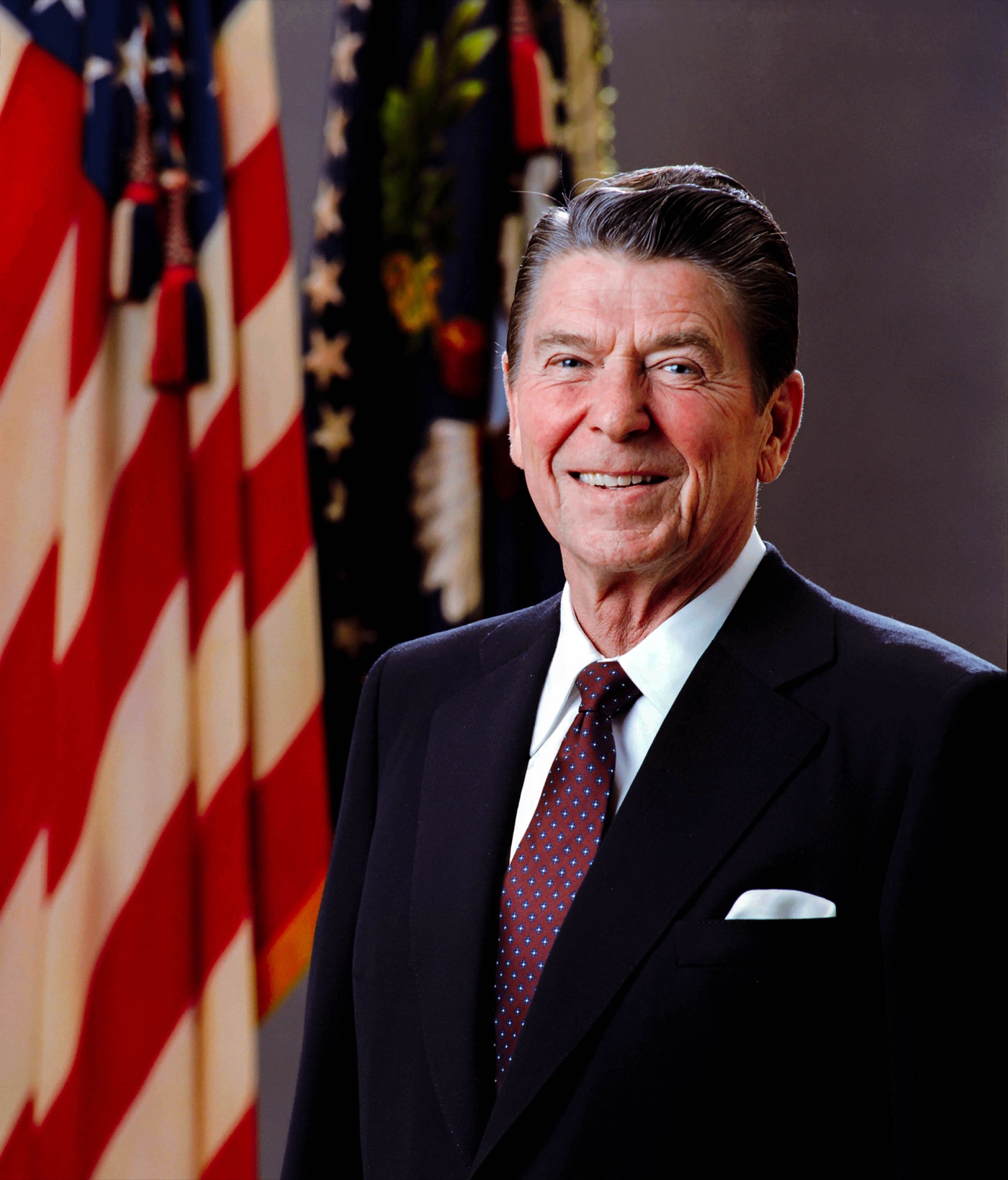
Ronald Reagan
Lifeguard, Sportscaster, Actor, Union President, 40th President of the United States
1911–2004 · Fortieth President of the United States · He put the line back in the draft every time
Michael's note
i picked him because i grew up in the 80s, when the cold war was a real thing. Reagan stepped outside of politics when it came to Americans. He made ALL Americans safe and proud, with grace and strength, not empty threats and fear.
Reagan entered public life in 1937, when Warner Bros. signed him. He made roughly fifty-three pictures. In Knute Rockne, All American he played George Gipp, the halfback who dies young, and delivered a deathbed line — win one for the Gipper — that followed him the rest of his life and eventually became a thing crowds shouted at him from behind rope lines in Ohio.
Fun Fact For Republicans
The Screen Actors Guild elected him president in 1947. He served six terms. In 1960 he took the Guild out on strike and won the residuals agreement — when your work is rerun, you get paid again. It still pays every working actor in America. The Republican icon was a union president who struck the studios and won.
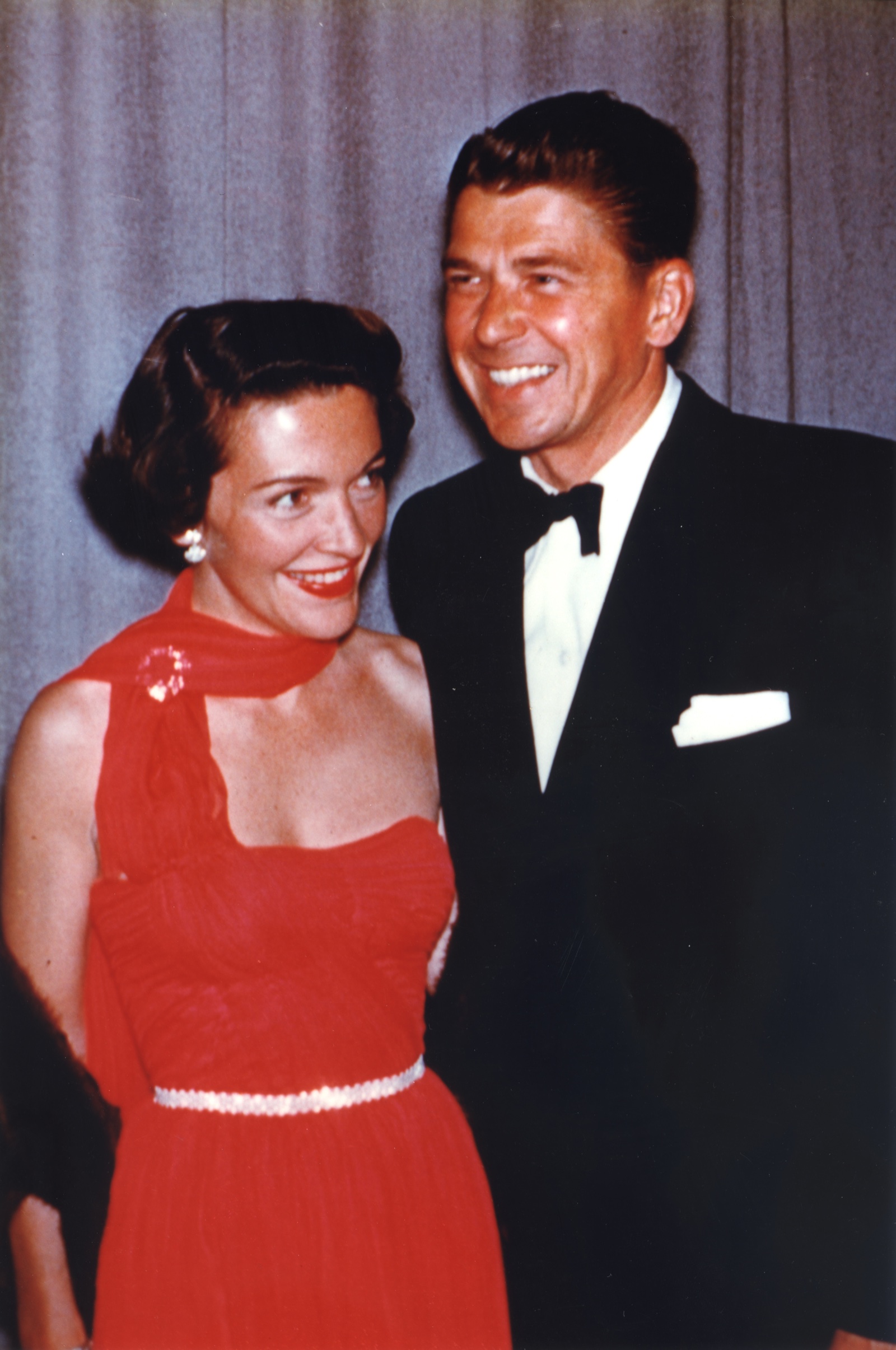
It was also the job that brought him Nancy Davis, who came to the Guild in 1949 to get her name off a blacklist she was never supposed to be on. That story is on the 40th first family's page.
General Electric Theater, 1954 to 1962. He hosted it, and the same contract sent him around the country to GE plants to speak to workers on the floor. He did that for eight years — thousands of rooms, no script, no teleprompter, no cameras, no coverage. That is where the political voice was actually built. Not in Hollywood and not later in Sacramento. On factory floors, in front of people who had to be back on the line in twenty minutes.
He was elected governor of California in 1967 and served two terms. In 1981 he was sworn in as President of the United States at sixty-nine, the oldest man ever to take the office to that point.
Sixty-nine days later he walked out a side door of the Washington Hilton and John Hinckley Jr. fired six rounds in under two seconds. One of them hit the limousine, flattened, and went into Reagan under the left arm. He did not know he had been shot. He thought his agent had cracked one of his ribs shoving him into the car.
March 30, 1981 — What the Country Was Not Told That Week
The public version was a president in good spirits, joking with his wife, discharged in under two weeks. The medical record is a different document. The bullet ricocheted off the limousine door, flattened, entered under his left arm, shredded his left lung, and stopped roughly an inch from his heart. He lost 3.7 quarts of blood — more than half of what a human body holds — and took eight units in transfusion across a surgery of nearly three hours. He was seventy years old. He was far closer to dying than anyone outside that room understood at the time. The jokes were made on the way there.
He walked into George Washington University Hospital under his own power, which was a decision and not a capability, and collapsed once he was through the door.
What everyone remembers is what he said. To Nancy, when she got there: Honey, I forgot to duck. To the surgical team, as they prepared to open his chest: I hope you're all Republicans. The lead surgeon, Joseph Giordano, a liberal Democrat, answered him: Today, Mr. President, we're all Republicans.
It is easy to file that under charm. It is not charm. A man with more than half his blood gone, minutes from dying, spent what attention he had left on making the people around him less frightened. That is a specific decision about who the room belongs to, and he made it while he could not properly breathe. That is what the word class actually describes when it is describing anything at all.
He was out of the hospital in under two weeks and the country's read on him permanently changed.
The presidency itself is argued about and always will be. What is not argued about is what happened between 1985 and 1988. He had called the Soviet Union an evil empire in a speech in Orlando in 1983 and he meant it. Then Mikhail Gorbachev took power, and Reagan did the thing almost no one who reaches that office is capable of doing in public. He revised.
Geneva in 1985. Reykjavik in 1986, where the two of them got within arm's reach of abolishing every nuclear weapon on earth before the talks collapsed over missile defense. And on June 12, 1987, at the Brandenburg Gate, with the wall behind him, he said the sentence.
The State Department wanted the sentence cut. The National Security Council wanted the sentence cut. It came out of the draft and he put it back. It came out again and he put it back again. He was told it was needlessly provocative and would humiliate Gorbachev, and he told his own staff he thought it was the right thing to say. Mr. Gorbachev, tear down this wall.
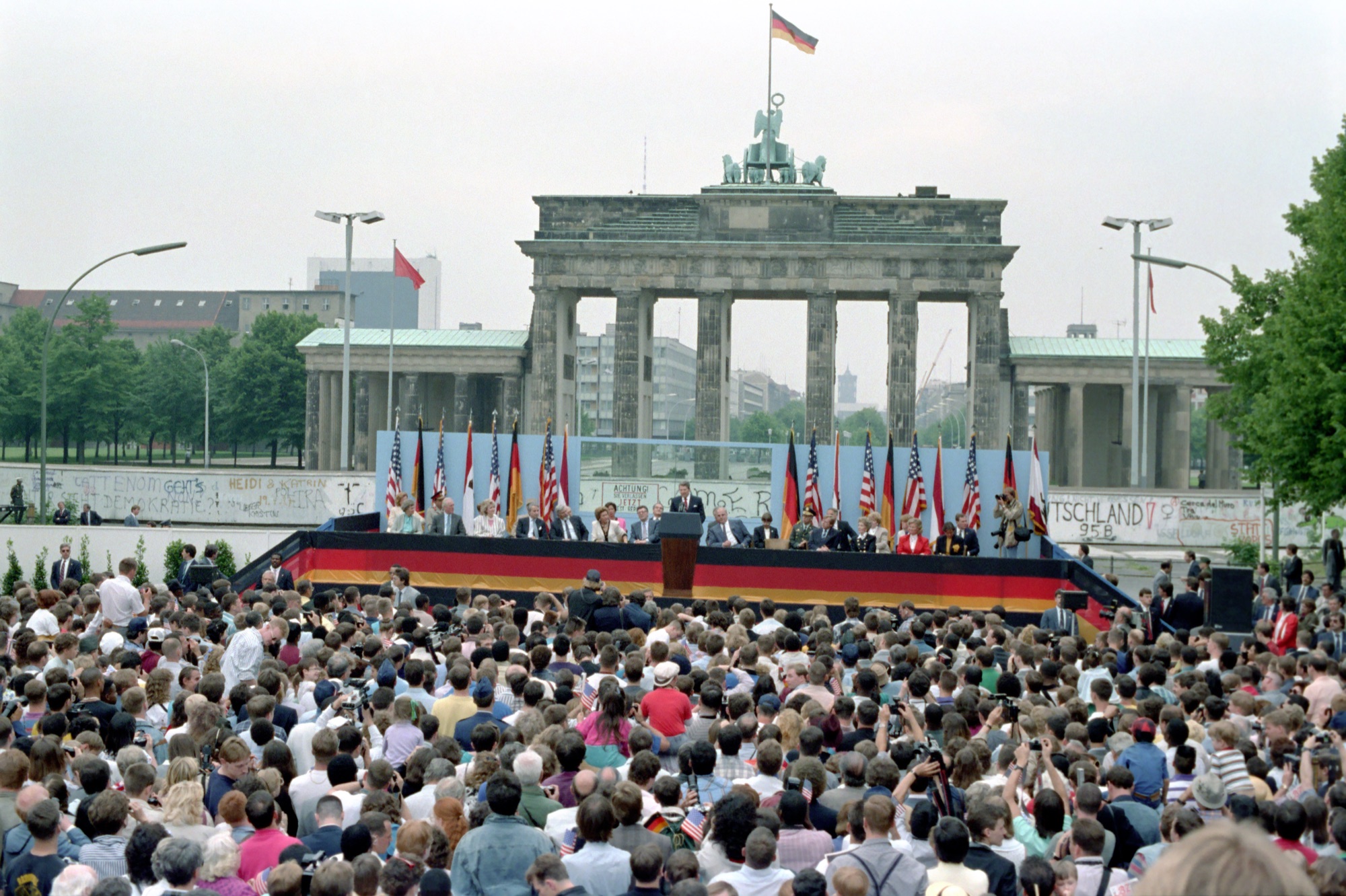
Brandenburg Gate, June 12, 1987. The wall is in the foreground with the graffiti still on it; the gate is behind. State and the NSC had cut the line from the draft more than once. He said it anyway.
On December 8, 1987, he and Gorbachev signed the INF Treaty in the East Room. It was the first arms control agreement in history to eliminate an entire class of nuclear weapons rather than cap them. Not slow the arsenal. Delete a category of it.
1937 to the Sunset — Sixty-Seven Years
1937
Warner Bros. signs him. Roughly fifty-three pictures follow, including the halfback who dies young.
1947
Elected president of the Screen Actors Guild. He will serve six terms.
1954–62
Hosts General Electric Theater and speaks on plant floors across the country. The political voice gets built here.
1960
Takes the Guild out on strike and wins the residuals agreement. Every working actor in America is still paid on reruns because of it.
1967
Elected governor of California. Two terms.
Mar 1981
Shot outside the Washington Hilton, sixty-nine days into the presidency. Loses more than half the blood in his body.
Mar 1983
Calls the Soviet Union an evil empire, in Orlando, and means it.
Nov 1985
Geneva. The first meeting with Gorbachev.
Oct 1986
Reykjavik. The two come within reach of abolishing every nuclear weapon on earth. The talks collapse over missile defense.
Jun 1987
Brandenburg Gate. State and the NSC cut the line out of the draft. He puts it back in every time.
Dec 1987
INF Treaty. The first agreement in history to abolish an entire class of nuclear weapons rather than cap it.
Jan 1989
Leaves office with the highest departing approval rating of any president since Franklin Roosevelt.
Nov 1989
The wall comes down, ten months after he leaves.
Nov 1994
Writes the Alzheimer's letter to the country in his own hand, at eighty-three, because he thinks it will help strangers. Nobody has done it since.
Jun 2004
Dies at ninety-three.
scroll →
On November 9, 1989, the wall came down. He had been out of office for ten months. He did not do it alone and he never once claimed he had — the people who did it were the ones standing on top of the wall in Berlin that night — but he was one of the people who built the room in which it became possible, and he is entitled to that.
He left office in January 1989 with the highest departing approval rating of any president since Franklin Roosevelt, went home to California, and had five ordinary years.
On November 5, 1994, he sat down at a desk in Los Angeles with a pen and a single sheet of paper and wrote to the country in his own handwriting. He was eighty-three. There was no press conference. There was no spokesman. There was no statement drafted by anybody else. He wrote that he had recently been told he was one of the millions of Americans who would be afflicted with Alzheimer's disease, that he and Nancy had decided to make it public rather than keep it private, and that they were doing it in the hope that it would raise awareness and spare other families some part of what was coming for his own.
Then he wrote the last line he would ever publish. I now begin the journey that will lead me into the sunset of my life.
Nobody made him do that. There is no rule anywhere requiring a former president to tell the country what is happening inside his own head. He had every ordinary human reason not to — pride, legacy, the simple preference for not being watched while you disappear. He did it anyway, and he did it while he could still hold the pen, because he thought it would help people he was never going to meet.
He lived ten more years, almost entirely out of view. He died on June 5, 2004, at ninety-three.
What Nancy Reagan did with the twelve years after that letter is the other half of this.
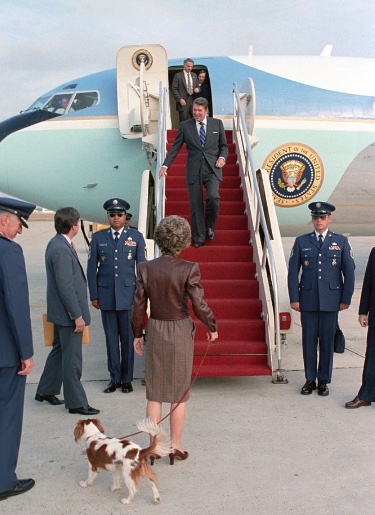
Coming down the steps of Air Force One. She is at the bottom of them, waiting, with the dog.
From Michael
I have lived through every presidency since Nixon, and looking back on them all, Reagan stands alone in my memory, for not only his political and economic achievements, but his unmatched ability to unite, and to show empathy when needed, strength when necessary, but never empty threats or the use of fear mongering. Here's to you, Gipper!
“I hope you're all Republicans.”
— Ronald Reagan, To the surgical team at George Washington University Hospital, minutes before they opened his chest — March 30, 1981
Spotlight Dispatch
These people were real. This praise is earned.